Scattered records
Learner, staff and parent information lives across files, messages and spreadsheets.
Bring learners, educators, parents, academics, attendance, finance and administration into one secure, connected platform.
Designed with POPIA requirements in mind. Mobile first. Offline capable.
Built around the realities of South African schools
POPIA-aware access
CAPS support
Offline first
Mobile first
Multi-language ready
Selah reduces duplicated work, brings the right information to the right role and keeps essential operations moving when connectivity is unreliable.
Learner, staff and parent information lives across files, messages and spreadsheets.
Leadership spends time reconciling data instead of acting on a reliable overview.
Critical attendance and mark capture cannot depend on a perfect internet connection.
A role-aware, multi-tenant platform designed for daily school operations, clear accountability and future growth.
Each module shares one secure school context, so information moves without being copied between systems.
Admissions, profiles, enrolment history, guardians, health details and documents.
Fast capture on any device, offline queueing and clear follow-up patterns.
Configurable assessments, seven-level achievement scale and report workflows.
Relevant messages, results, attendance and fees for each parent’s own children.
Fee structures, invoices, payments, balances, exemptions and reporting.
Coordinate classes, rooms, subjects and educators with fewer conflicts.
Profiles, qualifications, workload, attendance and development records.
SGB records, meetings, policies, training and controlled documentation.
Operational insight, audit trails and export-ready reporting workflows.
Principals see the whole school. Teachers focus on assigned classes. Parents see only their own children. Each experience stays useful and appropriately scoped.
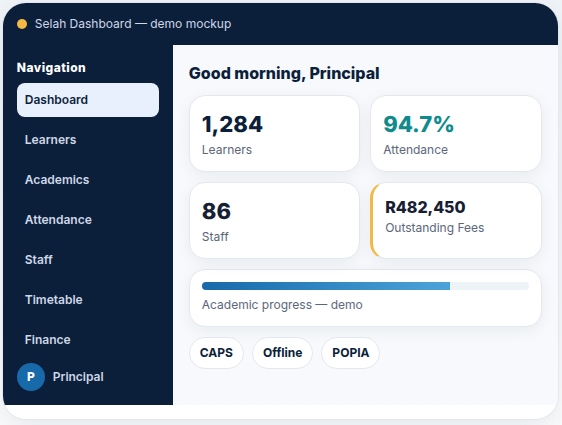
See attendance, academics, fees, tasks and school activity without hunting through disconnected tools.
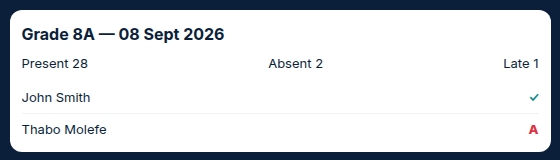
Capture critical work, see sync status and continue confidently during connectivity interruptions.

Give families a simple mobile view of attendance, results, fees, events and messages.
Selah responds to local curriculum structures, privacy obligations, mobile usage and the practical reality of intermittent connectivity.
See how Selah fits your schoolSupport phases, grades, subjects, terms, SBA and exam weighting, and the seven-level achievement scale.
Role-based access, audit logging, data minimisation and controlled handling of sensitive records.
Attendance and marks are designed to queue offline and synchronise when connectivity returns.
A foundation for SMS, email, WhatsApp and in-app messaging with accountable communication logs.
A structured rollout helps your team adopt Selah without disrupting the school day.
Configure your school, roles, grades, classes and secure user access.
Import, validate and organise the records your team needs to work confidently.
Use shared workflows, timely insight and clear communication to keep the school moving.
Tell us about your school and we will tailor the conversation around your learners, current processes and priorities.
Request a personalised demoNo public email address. Your details are handled through the secure request form.
A practical overview of how Selah is being designed and introduced.
Is Selah designed for South African schools?
Yes. Selah is designed around South African administration, curriculum, communication, privacy and connectivity requirements.
Does Selah support CAPS?
Selah supports configurable CAPS-related structures, including phases, grades, terms, weighting rules and the seven-level achievement scale.
Can Selah work without internet?
Critical workflows such as attendance and mark capture are designed to work offline and synchronise when connectivity returns.
What can parents access?
Parents are limited to their own children’s attendance, results, fees, timetable, events and relevant communication.
How do we request a demo?
Use the Request a Personalised Demo form. The questions help our team understand your school size, priorities and current systems before the conversation.